Your Resume Has the Right Skills, But ATS Still Can't Find Them. Here's How to Describe Skills on Resume the Right Way
Your resume has the right skills, but ATS may be missing them. Discover how to describe skills on your resume to get noticed by recruiters.

You spent a whole weekend on your resume. You have the experience. You have the skills. You hit "Apply" on 40 jobs. And then... nothing. No calls. No emails. Not even a polite "thanks, but no." If that sounds familiar, the fix is usually learning how to describe skills on resume so hiring software can find them and a real person believes them.
Here's what nobody tells you: the problem usually isn't your skills. It's the words you used to describe them. This guide is written mainly for job seekers in the USA, with clear notes for Canada, the UK and other markets too.
Everything here is backed by real numbers from Jobscan, the U.S. Bureau of Labor Statistics, Statistics Canada, the World Economic Forum and LinkedIn. No fluff. Let's get into it.
The quick answer (if you only have 30 seconds)
ATS software misses good candidates because their resumes don't use the exact words employers search for. Fix it in four moves:
- Use the employer's words. If the job post says "Power BI," don't just write "built reports."
- Prove every skill. Put your key skills inside your work bullets, with a tool and a number.
- Keep the format simple. Standard headings, no text boxes, no skills hidden in graphics.
- Tailor for each serious job. Aim for about 70–80% overlap with the skills the posting really needs, but only skills you truly have.
Key stats at a glance:
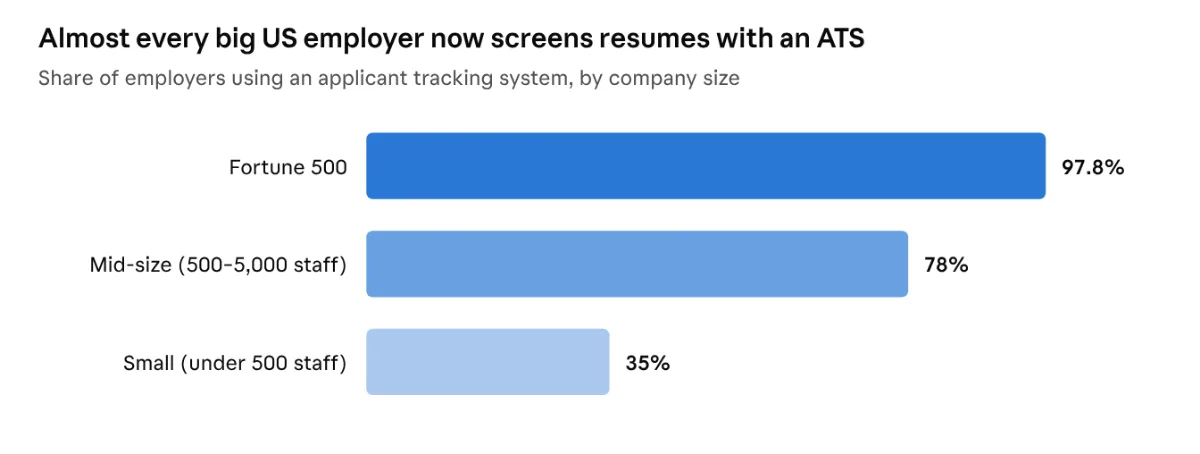
- 97.8% of Fortune 500 companies use an applicant tracking system (Jobscan, 2025).
- About 78% of mid-size companies and 35% of small companies use one too.
- The U.S. had 7.5 million job openings in September 2026 (BLS).
- 28.5% of Canada's job vacancies stayed open 90 days or more in Q4 2025 (Statistics Canada).
- 7 in 10 employers worldwide call analytical thinking an essential skill (World Economic Forum, 2025).
First, what is an ATS (and why should you care)?
An applicant tracking system (ATS) is software that companies use to collect, sort, search and rank job applications. Think of it as a very fast, very literal filing clerk. It pulls out your job titles, employers, dates, education, certifications, tools and skills. Then recruiters type search terms to filter the pile.
And it's everywhere. Jobscan checked the career pages of all Fortune 500 companies in 2025 and found an ATS on 489 of the 500. That's 97.8%.
So what does this mean for you?
- Applying to a big company? Assume a robot reads your resume first.
- Applying to a mid-size company? Still optimize for ATS, but a human may look sooner.
- Applying to a small business? A person probably reads it, but clear formatting and real proof still win.
Here's the key part. An ATS doesn't "understand" your resume the way a person does. It looks for exact terms, standard section names and dates it can read. So a brilliant candidate can get buried just because they said things differently than the job post.
4 reasons the ATS can't find skills you clearly have
1. You and the employer speak different languages
This is the big one. You write "built reports." The recruiter searches for "SQL," "Power BI," "data visualization" or "business intelligence." You did the exact same work, but the software doesn't connect the dots.
The fix is simple: borrow the job post's wording, but only when it honestly describes what you did. Never claim a tool, certification or level you can't defend in an interview. That backfires fast.
2. You listed skills but never proved them
A Skills section helps the ATS spot keywords. But on its own, it's just a list. Anyone can type "project management."
The strongest resumes repeat their top skills inside the work experience bullets. That's where a reader sees the tool, the action and the result together. Look at the difference:
| Weak wording | Strong, ATS-friendly wording |
|---|---|
| "Data analysis" | "Analyzed SQL-based sales data in Power BI to identify underperforming regions, supporting a 12% improvement in quarterly forecast accuracy." |
| "Project management" | "Led a six-person cross-functional project using Asana, delivering a customer-onboarding workflow two weeks ahead of schedule." |
| "Communication skills" | "Presented monthly performance findings to 15 stakeholders and translated technical issues into prioritized action plans." |
| "AI skills" | "Used ChatGPT and prompt engineering to draft, test and refine customer-support responses, reducing average handling time by 18%." |
See it? The right side has keywords for the robot and proof for the human. That's the sweet spot.
3. Your fancy design is confusing the software
That beautiful two-column template with icons and skill bars? It might look great to you. To an ATS, it can look like a mess. Parsing often breaks on:
- Graphics-heavy designs and text inside images
- Complex tables and text boxes
- Key info (like your contact details) tucked in headers or footers
- Creative section names like "My Toolbox" or "Where I've Been"
Stick with a simple, reverse-chronological layout. Use plain headings like "Work Experience," "Education" and "Skills." Use standard fonts. And send the file type the employer asks for.
4. You're targeting a job title, not the actual job
Two "Marketing Manager" jobs can want totally different things. One wants paid ads. Another wants email campaigns, analytics or CRM work. Same goes for a "Data Analyst" role: one leans on SQL and Python, another on Tableau and talking to stakeholders.
Tailoring doesn't mean copy-pasting the job description. It means picking the 8–12 skills from the posting that genuinely fit you, then showing them through your own wins.
How to describe skills on resume: the simple 3-layer method
You don't need more skills. You need to present the ones you have in a way both the software and a busy recruiter can't miss. Here's the method:
- Extract. Grab the job posting and highlight every tool, method, certification, industry term and must-have ability.
- Match honestly. Cross out anything you can't back up. Keep only what you can prove through work, school, projects, volunteering or a real credential.
- Place it smartly. Put your most important terms in three spots: your headline or summary, your Skills section and, most importantly, your experience bullets.
That third layer is where most people stop short. A skill that only shows up in a list looks like a claim. A skill that shows up in a bullet with a number looks like a fact.
A simple formula for every bullet: action verb + tool or method + what you did + a measurable result.
For example: "Built (action) a Power BI (tool) churn dashboard using SQL data (task), helping the team prioritize 200 at-risk accounts (result)."
Where to put your skills on a resume
Each part of your resume has a different job. Here's how to use each one:
| Resume section | What it's for | Example |
|---|---|---|
| Headline / target title | Show you fit the role in one glance | "Customer Success Manager | SaaS Retention | Salesforce | SQL" |
| Professional summary | Highlight your 2–3 strongest, most relevant skills | "Customer-success professional with 6 years in SaaS retention, Salesforce administration and data-driven churn analysis." |
| Skills section | List concrete, searchable hard skills | "SQL | Power BI | Salesforce | A/B Testing | Customer Onboarding" |
| Experience bullets | Prove skills with real outcomes | "Built a Power BI churn dashboard using SQL data, enabling the CS team to prioritize 200 at-risk accounts." |
| Projects / certifications | Back up career changers and newer professionals | "Google Data Analytics Certificate: completed SQL, Tableau and R capstone project." |
Swap vague words for specific ones
Vague words are invisible to an ATS. Nobody searches for "good with computers." Specific nouns beat broad adjectives every single time.
| Instead of this | Write this (if it's true) |
|---|---|
| "Good with computers" | Microsoft Excel, Google Workspace, Salesforce, Zendesk |
| "Data skills" | SQL, Excel, Power BI, Tableau, data cleaning, dashboarding |
| "Leadership" | "Led a team of 5," "managed vendor relationships," "facilitated weekly standups" |
| "Marketing" | SEO, Google Ads, HubSpot, email lifecycle campaigns, conversion-rate optimization |
| "AI" | Prompt engineering, ChatGPT, Claude, GitHub Copilot, AI-assisted workflow automation |
| "Strong communicator" | Stakeholder presentations, executive reporting, client onboarding |
How many skills should you list?
There's no magic number. But a focused list almost always beats a giant one. A good range is 8–15 highly relevant hard skills, grouped by category. Then weave soft skills like teamwork into your bullets instead of listing them as empty words.
| If you are... | How many skills | What to focus on |
|---|---|---|
| Early-career | 8–12 | Academic projects, internships, certifications |
| Experienced professional | 10–15 | Tools and methods from recent, relevant roles |
| Career changer | 8–12 | Transferable and technical skills, with a Projects section as proof |
| Executive | 8–12 | Strategic abilities, scope, outcomes, leadership |
| Technical specialist | 10–20 | Fine if grouped and every one is believable |
How often should you tailor your resume?
For every job you really want. Especially when the posting uses different terms, a different seniority level, a new industry or a different set of tools.
A handy target: aim for roughly 70–80% overlap between your Skills section and the skills the posting truly requires. Honest matches only.
The good news? You don't have to rewrite everything each time. Keep one master resume with all your proven wins. Then for each job, just tweak four things: the headline, the summary, the skills list, and the focus of 3–6 experience bullets.
Which skills are employers actually looking for?
Employers want a mix of tech skills and human skills. According to the World Economic Forum's Future of Jobs Report 2025, analytical thinking is still the number one core skill. Seven in 10 companies call it essential. Meanwhile, AI and big data, cybersecurity and tech literacy are the fastest-growing skill areas.
But here's the surprise. Look at which skills jumped the most in employer demand between 2023 and 2025:
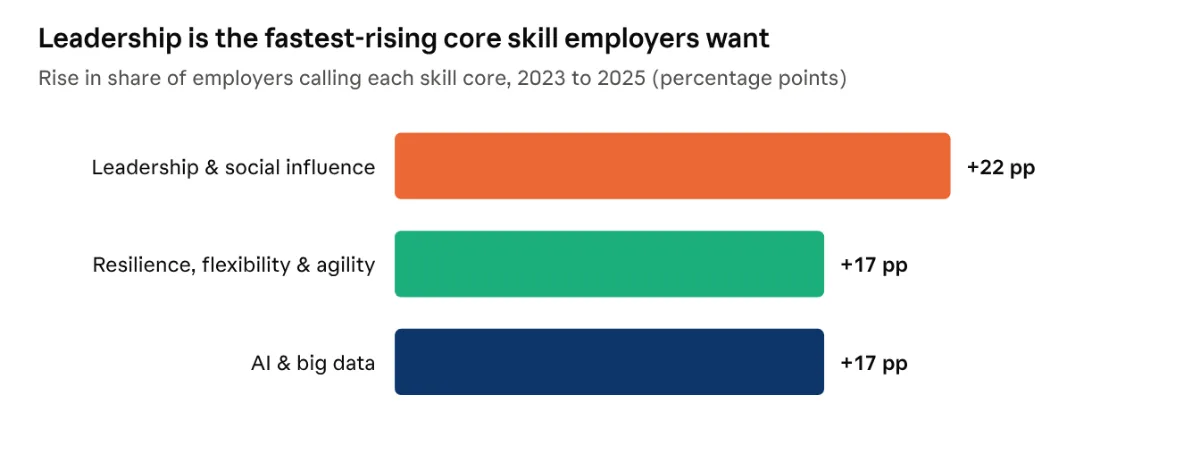
Yes, leadership grew even faster than AI. So don't hide your people skills. Just prove them, the same way you'd prove a technical one. Here's what that looks like:
| Skill area | Why employers care | How to show it on your resume |
|---|---|---|
| Analytical thinking | They need people who can read information and make good calls | "Analyzed customer-feedback data to identify three service gaps and proposed a revised escalation process." |
| AI and big data | AI is changing how work gets done | "Used AI-assisted research and prompt design to reduce content-production cycle time by 25%." |
| Tech literacy | Everyone uses digital tools now, in every role | "Migrated team documentation to Notion and trained 12 colleagues on standardized workflows." |
| Cybersecurity | Digital risk keeps growing in every industry | "Implemented multi-factor authentication and access-review procedures for a 40-user team." |
| Resilience and agility | Roles and tools keep changing | "Rebuilt a reporting process after a system migration, maintaining on-time delivery for 6 consecutive months." |
| Leadership and influence | Cross-team work needs people who can align others | "Led weekly planning sessions across product, design and support to launch a feature on schedule." |
What this means in the USA job market
The U.S. still has plenty of jobs. The problem is matching people to the exact skills each role needs. The Bureau of Labor Statistics (BLS) reported 7.5 million job openings in September 2026, with an openings rate of 4.5%.
| U.S. signal | Latest figure | What it means for your resume |
|---|---|---|
| Job openings, Sept 2026 | 7.5 million | Jobs exist, but screening is still tough |
| Job-openings rate | 4.5% | Employers can be picky, so relevance beats volume |
| Projected openings per year, 2025–35 | About 17 million | Keep a master resume and refresh your skills often |
| Skilled-trades shortage | Nearly 1.9 million workers (2026 industry estimate) | Trades workers should lead with licenses, safety training, equipment and project results |
Tip for U.S. applicants: skip empty buzzwords like "results-driven" unless you back them up. Use the employer's exact names for tools, compliance rules and systems, and tie them to business results.
What about Canada?
Canada has the same skills gap. Statistics Canada reported 495,100 job vacancies in Q4 2025. That's 8.9% fewer than a year before. But 28.5% of those jobs had been open for 90 days or more. Employers simply couldn't find the right fit.
The Future Skills Centre found that 28% of Canadian small and mid-size businesses struggled to fill jobs between April and August 2025. Here's why:
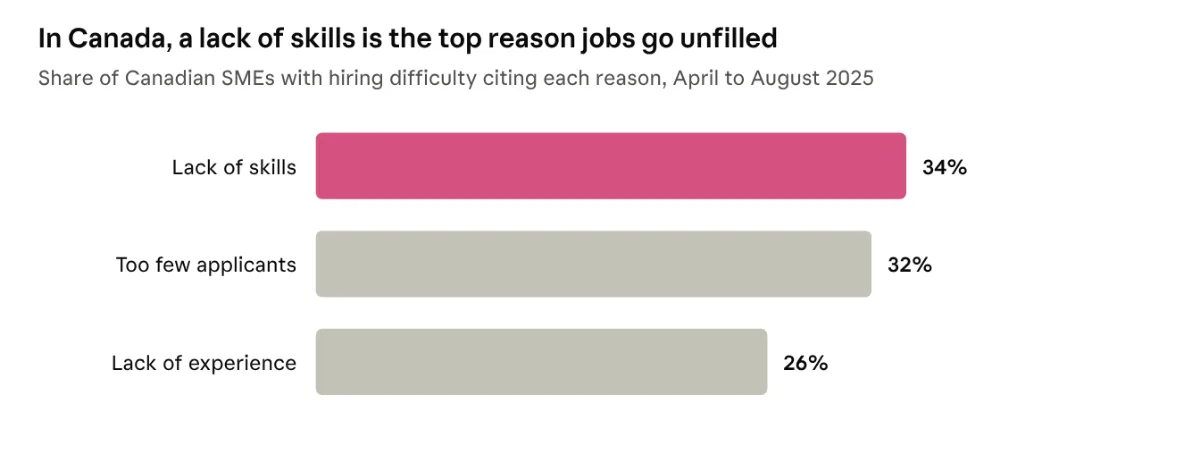
Looking ahead, digital skills are the most expected future need, named by 21% of employers. So be specific with digital terms. Don't write "tech-savvy." Name the actual tools.
Tip for Canadian applicants: watch for local terms like "provincial," "CPA," "Red Seal," "P.Eng.," "PHIPA," "PIPEDA" and "bilingual." Use them only if they truly apply to you, especially regulated job titles.
The UK and the rest of the world
Around the globe, companies care more about proof of skills than degree titles. LinkedIn's Future of Recruiting 2025 report calls skills-based hiring a growing priority.
In the UK, about two-thirds of organizations now use skills-based hiring, according to 2026 research cited by CNBC. And nearly 60% of candidates said they're more likely to apply when a job is described by skills instead of degrees or career history.
| Market | The big trend | What to do on your resume |
|---|---|---|
| USA | High ATS use, lots of openings, ongoing skill gaps | Use precise, ATS-readable skill words and numbers |
| Canada | Vacancies stay open because of skill and experience gaps | Show verifiable credentials, digital skills and role-specific proof |
| United Kingdom | Strong shift to skills-based hiring | Lead with what you can do and what you achieved, not just titles |
| Global | AI, data, cybersecurity and tech literacy rising; human skills still critical | Pair tech skills with proof of communication, adaptability and leadership |
6 common mistakes that quietly kill your chances
- Keyword stuffing. Repeating "project management" ten times makes your resume hard to read and proves nothing.
- Vague categories. "Data," "marketing" and "leadership" are too broad. Name the tools, methods and results.
- Soft skills with no proof. Don't just say you're a great communicator. Show a time you presented, trained or persuaded someone.
- One resume for every job. A job title alone doesn't tell the employer you have the specific skills they need.
- Ignoring the exact phrasing. If the posting says "JavaScript," "Salesforce" or "stakeholder management," use that exact phrase when it's true for you.
- Over-designing. Text boxes, images, icons and quirky section names make the ATS stumble.
A 7-step workflow you can repeat for every job
- Collect 3–5 job postings for the same role and industry.
- Highlight the skills, tools, certifications and terms that keep showing up.
- Split them into "required" and "preferred." Focus on the required ones you really have.
- Write bullets using this formula: action verb + tool or method + task + measurable result.
- Clean up the format: clear headings and a simple, readable layout.
- Do a final check. Every major skill you claim should appear in context at least once.
- Update your master resume every quarter, or whenever you finish a project, earn a certification or learn a new tool.
Ready-to-use resume example
Here's what all of this looks like put together, for a Customer Success Manager. Swap in your own details.
Professional Summary
Customer Success Manager with 6+ years of experience in SaaS retention, Salesforce administration, SQL-based reporting and cross-functional onboarding. Reduced churn risk through data-driven account reviews and improved customer adoption through scalable enablement programs.
Skills
- CRM & Data: Salesforce, HubSpot, SQL, Power BI, Excel
- Customer Success: Onboarding, retention, churn analysis, QBRs, customer education
- Leadership: Cross-functional collaboration, stakeholder management, process improvement
- AI & Productivity: ChatGPT, prompt engineering, workflow automation
Experience bullet example
Built a Power BI dashboard using SQL data to identify 200 high-risk accounts; partnered with Customer Success managers on outreach plans that contributed to a 12% improvement in quarterly retention.
Notice how "Power BI" and "SQL" show up in the Skills list and again in a real result. That's exactly what both the ATS and the recruiter want to see.
Frequently asked questions
Why does ATS reject resumes with the right skills?
Usually because the resume uses different words than the job posting, hides skills in a list without proof, or uses a layout the software can't read. The ATS isn't judging your talent. It's matching words.
What percentage of companies use an ATS?
Jobscan's 2025 audit found an ATS on 97.8% of Fortune 500 career pages. Roughly 78% of mid-size companies (500–5,000 employees) and about 35% of small companies (under 500 employees) use one.
How many skills should I put on my resume?
Most people should list 8–15 highly relevant hard skills, grouped by category. Technical specialists can go up to about 20 if every one is believable.
Should I copy keywords straight from the job description?
Use the employer's exact terms, but only for things you've genuinely done. Don't copy whole sentences, and never claim a tool or certification you can't talk about in an interview.
Should soft skills go in my Skills section?
It's better to prove them in your experience bullets. "Presented monthly findings to 15 stakeholders" says more than "great communicator."
How much should my resume match the job posting?
A useful target is about 70–80% overlap between your Skills section and the posting's truly required skills, with honest matches only.
Do resumes in Canada and the UK work the same way?
Mostly, yes. In Canada, include real credentials and local terms like "Red Seal" or "CPA" when they apply. In the UK, skills-based hiring is common, so lead with what you can do and the results you got.
Final thoughts
Your skills were never the problem. The ATS just needs you to speak its language, and the recruiter needs to see proof. Use the employer's words, back every skill with a real result, keep your layout clean and tailor for the jobs you really want.
So pull up your resume tonight. Pick one job you'd love to land. Then use this guide on how to describe skills on resume to rewrite just three bullets. You'll be surprised how different it reads, to the robot and to the human.
Sources
- World Economic Forum, Future of Jobs Report 2025 and Skills Outlook
- Jobscan, State of the Job Search in 2025; 2026 Applicant Tracking System Usage Report
- U.S. Bureau of Labor Statistics, Job Openings and Labor Turnover Survey (September 2026); Employment Projections, 2025–35
- Statistics Canada, Job Vacancies, Fourth Quarter 2025
- Future Skills Centre, Employment Practices and Skills Demands in Canada
- LinkedIn, Future of Recruiting 2025
- CNBC, "AI broke the job application. What replaces it?" (September 2026)